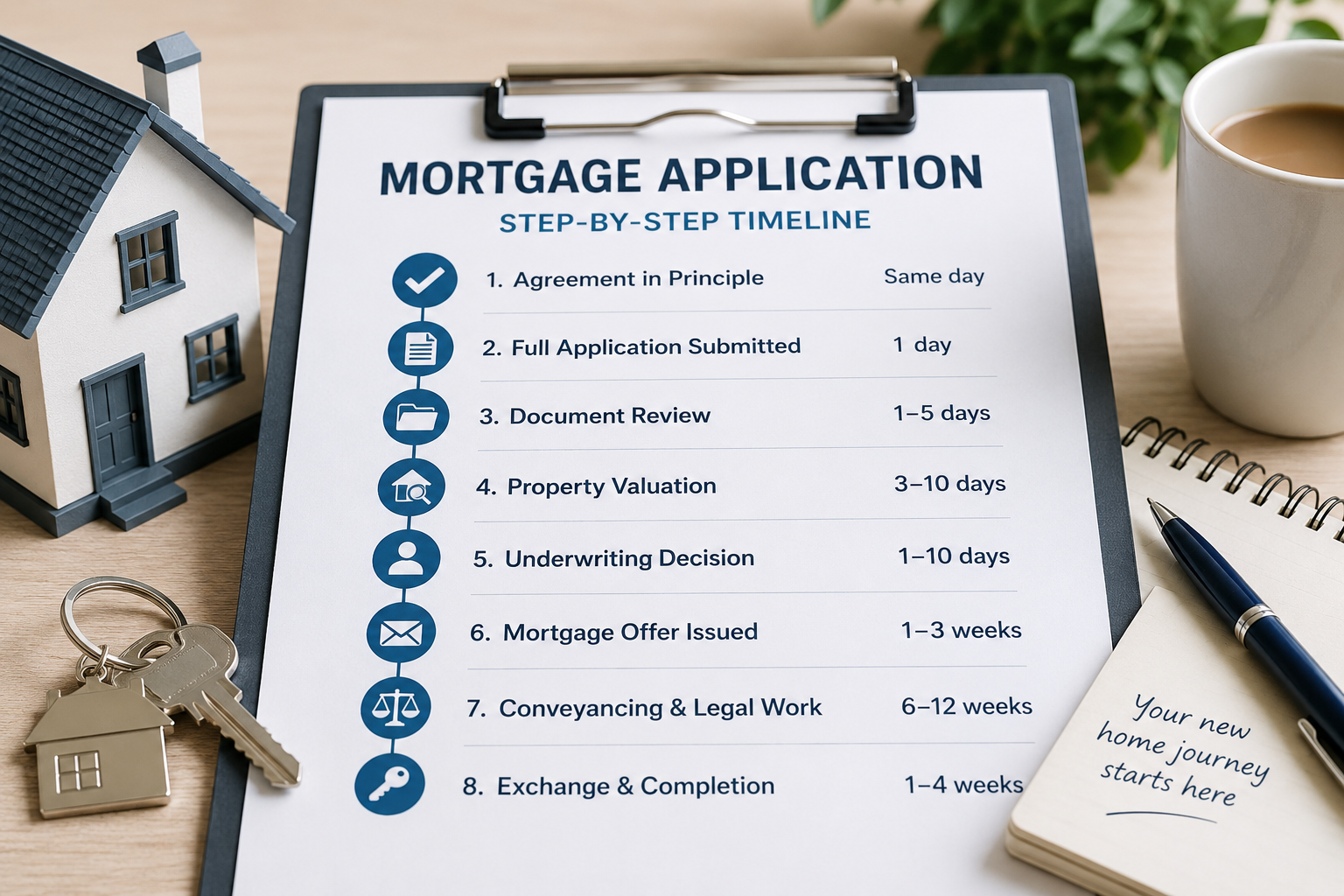
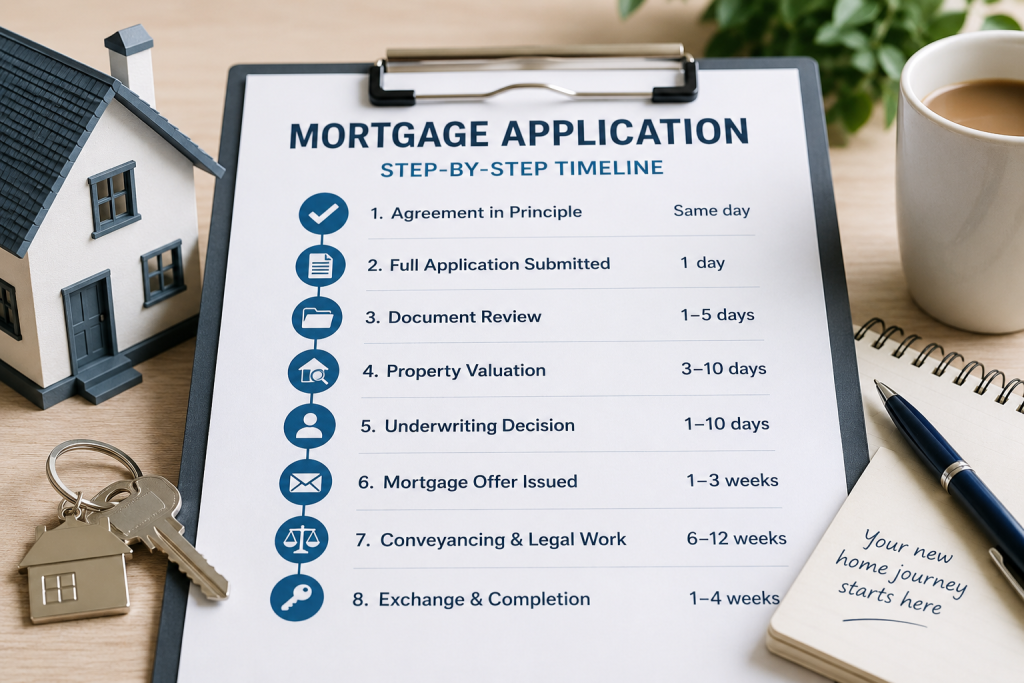
Wondering how long a mortgage application takes? It’s one of the most common questions we get from home buyers. While many people assume the process takes months, the reality is that a straightforward mortgage application can often be approved within 1-3 weeks, with the entire home buying process typically taking 8-16 weeks from offer accepted to getting the keys.
The exact timeline depends on factors such as your circumstances, the lender you choose, how quickly documents are provided, and whether there are any issues with the property or legal work.
In this guide, we’ll walk you through each stage of the mortgage process so you know exactly what to expect.
Quick Overview: Mortgage Application Timeline
| Stage | Typical Timescale |
|---|---|
| Mortgage Agreement in Principle | 5 minutes – 24 hours |
| Full Mortgage Application | 1 day |
| Document Review | 1–5 working days |
| Property Valuation | 3–10 working days |
| Underwriting Decision | 1–10 working days |
| Mortgage Offer Issued | 1–3 weeks after application |
| Conveyancing & Legal Work | 6–12 weeks |
| Exchange & Completion | Usually 1–4 weeks after contracts exchanged |
Step 1: Get a Mortgage Agreement in Principle (Same Day)
An Agreement in Principle (AIP), sometimes called a Decision in Principle (DIP), is the first step.
The lender carries out a basic affordability assessment and usually a credit check before confirming how much they’re prepared to lend.
This isn’t a mortgage offer, but it demonstrates to estate agents and sellers that you’re in a strong position to proceed.
Typical time:
5 minutes to 24 hours
Step 2: Find Your Property
Once you have your Agreement in Principle, you can confidently begin house hunting.
This stage is impossible to predict—it could take a weekend or several months depending on the market.
Once your offer is accepted, the mortgage process begins properly.
Step 3: Submit the Full Mortgage Application (Usually One Day)
Your mortgage adviser will gather all the necessary information before submitting the application.
Typical documents include:
- Proof of identity
- Proof of address
- Payslips
- P60
- Bank statements
- Self-employed accounts or tax calculations (if applicable)
- Deposit evidence
The more organised you are, the quicker this stage moves.
Typical time:
Same day
Step 4: Initial Underwriting (1–5 Working Days)
Once your application reaches the lender, it is allocated to an underwriter.
They’ll review:
- Your income
- Employment
- Credit history
- Deposit
- Bank statements
- Affordability calculations
If anything is missing, they’ll request further information.
This is one of the stages where delays most commonly occur.
Typical time:
1–5 working days
Step 5: Property Valuation (3–10 Working Days)
The lender will arrange a valuation of the property.
This isn’t a detailed survey—it’s simply to ensure the property provides adequate security for the mortgage.
Depending on the lender and property type, this may involve:
- Automated valuation
- Desktop valuation
- Physical inspection
Typical time:
3–10 working days
Step 6: Final Underwriting (1–5 Working Days)
Once the valuation has been returned, the underwriter carries out a final review.
If everything is satisfactory, they’ll approve the mortgage.
Occasionally they may ask for:
- Updated payslips
- Additional bank statements
- Explanation of transactions
- Gifted deposit evidence
- Employer confirmation
Responding quickly helps avoid unnecessary delays.
Step 7: Mortgage Offer Issued (Usually Within 1–3 Weeks)
This is the stage everyone waits for.
The lender issues a formal mortgage offer confirming:
- Loan amount
- Interest rate
- Monthly payments
- Mortgage term
- Special conditions
The offer is sent to both you and your solicitor.
Typical time:
1–3 weeks after submitting the application
Some lenders can issue offers within just a few days, while more complex applications can take several weeks.
Step 8: Conveyancing (6–12 Weeks)
Although your mortgage has been approved, you’re not ready to move in just yet.
Your solicitor now handles:
- Property searches
- Reviewing contracts
- Raising enquiries
- Checking the title
- Liaising with the seller’s solicitor
- Arranging mortgage funds
This legal work often takes longer than the mortgage itself.
Typical time:
6–12 weeks
Step 9: Exchange of Contracts
Once everything is ready:
- Contracts are exchanged
- The completion date is agreed
- The transaction becomes legally binding
At this point, both buyer and seller are committed to the sale.
Step 10: Completion Day
Congratulations—you get the keys!
Your solicitor receives the mortgage funds from the lender, transfers the money to the seller’s solicitor and ownership officially changes hands.
What Can Delay a Mortgage Application?
While many applications proceed smoothly, several issues can slow things down.
Common causes include:
- Missing documents
- Slow responses to lender queries
- Complex income (self-employed, contractors or multiple jobs)
- Gifted deposits requiring additional checks
- Credit history issues
- Down-valuations
- Leasehold or unusual properties
- Busy periods for lenders
- Delays with solicitors
Many of these delays can be reduced by working with an experienced mortgage adviser who ensures the application is accurate before submission.
How to Speed Up Your Mortgage Application
Here are some simple ways to keep things moving:
Have your documents ready
Gather payslips, bank statements and ID before you apply.
Respond quickly
If your lender or adviser requests information, send it as soon as possible.
Avoid changing your finances
Try not to:
- Change jobs
- Take out new finance
- Miss payments
- Make unusually large bank transfers
until after your mortgage has completed.
Use an experienced mortgage broker
A broker can identify the most suitable lender for your circumstances and help avoid many of the common reasons applications are delayed.
Frequently Asked Questions
How long does a mortgage application take from start to finish?
The mortgage approval itself usually takes 1-3 weeks, while buying a property typically takes 8-16 weeks including legal work.
Can a mortgage be approved in a week?
Yes. Some straightforward applications with high-street lenders can receive an offer within a few working days, particularly if an automated valuation is used.
What stage usually takes the longest?
In most purchases, the conveyancing process takes longer than the mortgage application itself.
Does using a mortgage broker make the process quicker?
A broker can’t make the lender work faster, but they can reduce delays by ensuring your application is submitted correctly the first time, choosing a lender suited to your circumstances, and dealing with any queries promptly.
Final Thoughts
The mortgage process often feels longer than it really is because there are several different stages happening at once. In many cases, the lender’s decision is relatively quick, while the legal work involved in buying a property is what determines the overall timeline.
Preparing your documents in advance, responding promptly to requests, and seeking professional advice can help make the process as smooth as possible.
If you’re planning to buy your first home, move house, or remortgage, speaking to an experienced mortgage adviser early can help you understand your options and avoid unnecessary delays.
🔗 Helpful Links
- Loan to Value Explained — The Complete Guide to Smarter Mortgage Decisions
- Why Use a Mortgage Broker? Top 7 Reasons to Get Expert Mortgage Advice
- AIPs, DIPs and MIPs- What’s the Difference?
- 7 Key Costs To Budget For When Buying A Home
- MoneyHelper (UK government-backed)
- FCA
Need Mortgage Advice?
At Mortgage Links, we guide clients through every stage of the mortgage process—from obtaining an Agreement in Principle through to receiving the keys.
Whether you’re a first-time buyer, home mover, self-employed, or looking to remortgage, we’re here to make the process as straightforward and stress-free as possible.
Get in touch today for expert, independent mortgage advice tailored to your circumstances.